Your retail brand’s reputation isn’t truly built on the showroom floor; it’s forged in the precise millimetres between a window frame and a custom blind. When you’re managing blind installation projects for retailers, you know that a single measurement error or a delayed shipment from overseas can quickly turn a profitable contract into a logistical headache. It’s often the silence between the showroom, the manufacturer, and the site that causes the most friction. We believe that professional project management should feel as smooth and effortless as the operation of a high-quality Zipscreen or a motorised Roller Blind.
We understand the pressure to maintain high standards while juggling tight commercial schedules. This guide will show you how to streamline your retail installation pipeline, reduce expensive remakes, and leverage the reliability of local Australian manufacturing for flawless delivery. We’ll explore how a dedicated partnership with a Brisbane manufacturer can help you achieve zero-error installations and higher referral rates. We’ll also cover the essential 2026 safety regulations and Automate™ technology trends that are currently defining the Australian market, ensuring your projects remain both beautiful and compliant.
Key Takeaways
- Understand the complete lifecycle of a retail blind project to effectively bridge the gap between homeowner expectations and technical manufacturing requirements.
- Discover why a dedicated “Check Measure” protocol is the most critical step in managing blind installation projects for retailers to eliminate expensive measurement errors.
- Learn how to synchronise delivery schedules and subcontractor coordination to ensure a seamless transition from the showroom to a flawless on-site installation.
- Gain insights into overseeing complex motorisation projects, including the necessary collaboration between installers and electricians for Automate™ smart home systems.
- Explore the strategic advantage of partnering with a local Brisbane manufacturer to reduce lead times and access direct support for premium Zipscreen™ and Rollease Acmeda® components.
What is Blind Installation Project Management for Retailers?
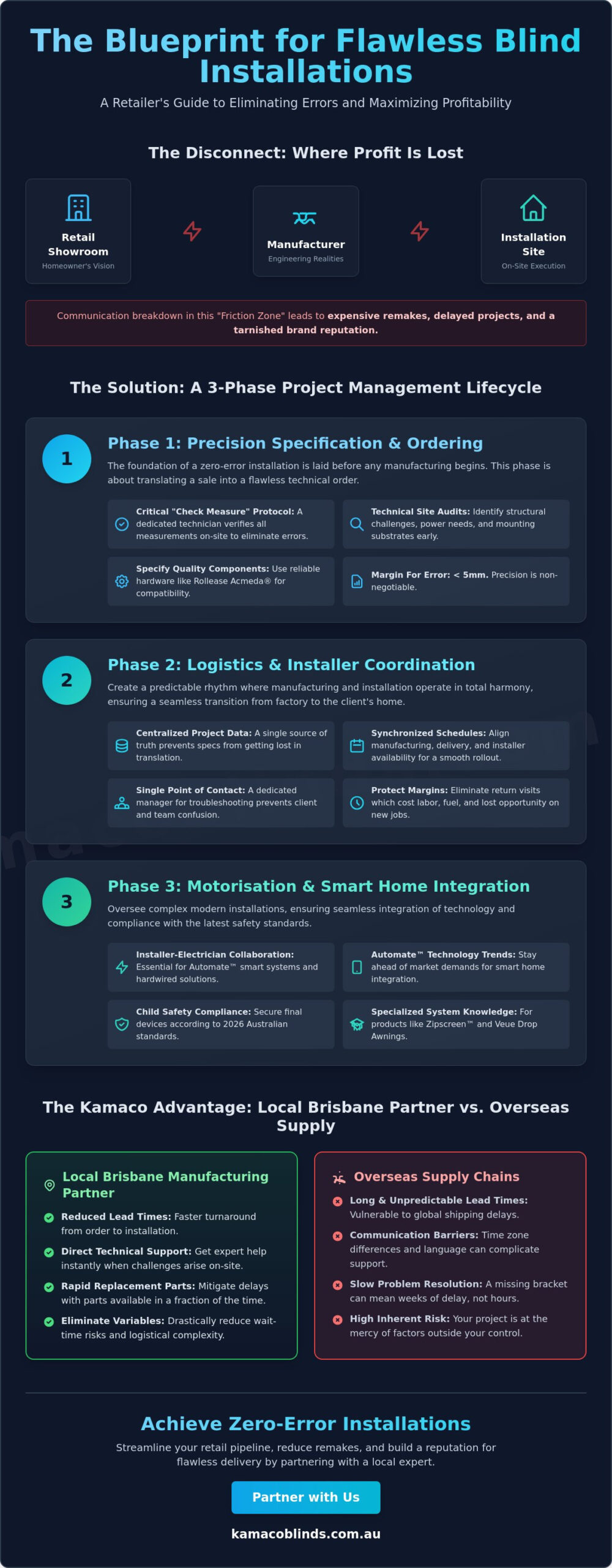
Managing blind installation projects for retailers is the deliberate orchestration of technical precision, logistics, and customer service. It isn’t merely the act of hanging a window covering; it’s a comprehensive lifecycle that begins with the initial consultation and concludes only when the final child safety device is secured according to the latest Australian standards. In this environment, you are applying fundamental project management principles to a specialised field where the margin for error is often less than five millimetres. Success requires seamless coordination between your sales consultants, office coordinators, and the installation teams on the ground.
As a retailer, you serve as the critical bridge between the homeowner’s lifestyle aspirations and the manufacturer’s engineering realities. You’re responsible for translating a customer’s desire for the perfect shade into a technical order that a factory can execute without ambiguity. When this communication breaks down, the financial consequences are immediate. Poor project management manifests as expensive remakes, frustrated return visits, and a tarnished reputation in a community where word-of-mouth is your most valuable asset. Protecting your brand means ensuring that every stakeholder is aligned from the moment the tape measure hits the wall.
The Logistics of a Seamless Rollout
Achieving a smooth rollout requires centralising project data to ensure that specifications don’t get lost in translation. This is particularly vital when managing blind installation projects for retailers that involve high-end, custom-made products like Zipscreen™ or Veue drop awnings. These systems require specific lead times and site preparations that must be communicated clearly to the client. By maintaining a single point of contact for troubleshooting, you prevent the confusion that arises when multiple people try to solve the same logistical puzzle. It’s about creating a predictable rhythm where the manufacturer and the installer operate in total harmony.
Protecting Retail Margins Through Precision
Every time an installer has to return to a site because of a missing bracket or a measurement oversight, your net profit on that job evaporates. The real cost of a return visit includes not just the technician’s hourly rate, but also the fuel and the lost opportunity to start a new, billable project. Choosing a local Brisbane manufacturer helps mitigate the wait-time risk that is inherent with overseas supply chains. If a challenge arises on-site, a local partner can provide technical support or replacement parts in a fraction of the time. Project management is the elimination of variables between the order form and the window frame.
Phase 1: Precision Specification and Ordering
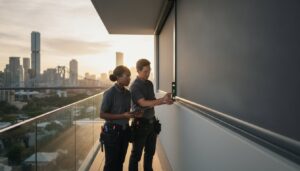
Precision is the cornerstone of every successful installation, and it begins long before the first bracket is fixed. When you’re managing blind installation projects for retailers, the transition from a showroom sale to a technical order is where most errors occur. It’s tempting to rely on a sales consultant’s initial estimates, but implementing a strict “Check Measure” protocol is essential. A dedicated technician’s eye will identify the slight wall tapers or recessed obstacles that a salesperson might overlook. This extra step ensures that the final product fits perfectly, preserving your profit margins and your professional reputation.
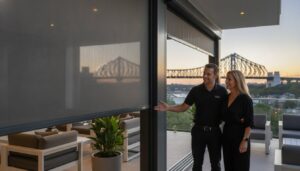
Reliability also depends on the quality of the internal components you specify. We utilise Rollease Acmeda® hardware to ensure total compatibility across different window types, providing a uniform aesthetic and smooth operation throughout a home. Specifying for complex outdoor systems like Zipscreen™ requires a different technical mindset than standard internal Roller blinds. You must account for wind loads, mounting substrates, and fabric tension. For retailers who require bespoke solutions with a faster turnaround, a “Cut Skin Service” can be a game-changer, providing precision-cut fabrics that are ready for immediate assembly or replacement on-site.
Technical Site Audits for Retailers
A technical audit identifies structural challenges like uneven cornices or external cladding before the order reaches the factory. This phase is also the time to assess power requirements for Automate™ motorisation systems. As the demand for motorization and smart home integrations continues to grow, ensuring you have the correct wiring or battery access points is vital for a clean finish. We recommend creating a repeatable “Measure Sheet” that mirrors your manufacturer’s order form to ensure no detail is missed during the site visit.
Standardising Your Ordering Process
Consistency reduces the cognitive load on your office team and minimises data entry errors. Utilising standardised wholesale blinds Australia order forms allows for a seamless transfer of information from the site audit to the production line. When managing blind installation projects for retailers, try to batch orders for multi-room residential projects. This approach ensures fabric consistency and simplifies delivery logistics. Always verify fabric orientation and seam placement for large-span products like Panel Glide blinds to ensure the aesthetic meets the homeowner’s high expectations. If you are looking to refine your current specification process, our team is always available to provide technical guidance on our full product range.
Phase 2: Logistics, Lead Times, and Installer Coordination
Once the technical specifications are finalised, the success of your project shifts from the desk to the driveway. Managing blind installation projects for retailers requires a delicate balance of timing, where the arrival of the product must align perfectly with the availability of your installation team. This logistical dance is what separates a chaotic rollout from a premium service experience. Vetting your subcontractors is the first step in this phase. These professionals are the face of your retail brand in the homeowner’s living room, so setting clear expectations for site conduct, professional attire, and meticulous cleanup is non-negotiable.
Synchronising delivery is equally vital to maintaining your margins. You want the custom-made Roller Blinds or Vertical Blinds to arrive at the showroom or directly on-site exactly when the installer is ready to pick up their tools. When products sit in storage for weeks, the risk of transit damage or lost components increases. We recommend being transparent with customers about manufacturing lead times from the outset. By providing regular updates, you build trust and reduce the “where is my order?” enquiries that can clog your office phone lines. This is where the “Brisbane Advantage” becomes a strategic asset. Partnering with a local manufacturer allows for agile adjustments to project timelines that overseas suppliers simply cannot match.
Scheduling for Maximum Efficiency
Efficiency in the field is often won through smart geographic grouping. By scheduling installations in clusters, such as grouping all North Brisbane jobs on a Tuesday and South Brisbane on a Wednesday, you significantly reduce travel time and fuel costs. Always allocate “buffer time” for more complex outdoor installations, such as Zipscreen™ systems or Veue drop awnings, which may require more nuanced adjustments than a standard internal blind. Using digital calendars allows your office team to provide real-time updates to the crew, ensuring everyone stays on track as the day progresses.
The Handover: From Showroom to Site
The transition from the showroom to the installer’s van is a frequent point of failure. To prevent this, prepare a comprehensive “Installation Pack” for every job that includes final specifications, site photos, and specific notes about the mounting surface. A successful installation begins with a detailed site pack that leaves no room for installer guesswork. Before the team departs, conduct a quick hardware check to ensure all specialised brackets and Automate™ remotes are accounted for. This small investment in time prevents the frustration of a technician arriving on-site only to realise a critical component is still sitting on a shelf in the warehouse.
Phase 3: Managing Motorisation and Smart Home Integrations
Motorised systems represent the highest-risk and highest-reward category in our industry. When you’re managing blind installation projects for retailers, these smart systems require a significantly higher level of project management oversight compared to manual alternatives. The complexity doesn’t just lie in the hardware; it’s in the digital handshake between the motor and the home’s network. A successful rollout ensures that the sophisticated beauty of a motorised Roller Blind is matched by its effortless function. Without meticulous planning, a premium project can quickly descend into a series of frustrating technical hurdles.
Coordinating between the blind installer and the electrician is the most critical logistical challenge for hardwired systems. If the wiring isn’t in the precise position when the installer arrives to hang a Zipscreen™ or a large-scale internal blind, the project stalls and your margins suffer. You must ensure that the electrical rough-in matches the technical specifications of the Automate™ motors you’ve specified. It’s your role as the project manager to facilitate this conversation, ensuring the electrician understands the specific torque and power requirements before the walls are closed up or the cladding is finished.
Programming the motors is a step that simply cannot be rushed or left to chance. It’s essential that the installer sets the precise upper and lower limits before they leave the site. This prevents the fabric from over-travelling and causing structural damage to the blind or the motor itself. Troubleshooting common connectivity issues during the handover is also part of the service. Whether it’s a signal interference or a pairing error with a Wi-Fi hub, resolving these technical “glitches” on the day is what defines a professional retail experience.
Automate™ vs. Manual: Managing the Value Add
Project management requirements differ significantly between battery-operated and DC-wired motors. Battery motors offer a simpler path for retrofitting, whereas hardwired systems provide the ultimate in long-term reliability for new builds. You should always ensure the customer is fully trained on the app or remote control before the final payment is requested. For a deeper look at the technical requirements of these systems, you can refer to our smart home motorised blinds Brisbane wholesale guide for 2026.
Post-Installation Quality Assurance
A robust post-installation quality assurance process prevents unnecessary call-backs and protects your reputation. We recommend a 5-point checklist for every motorised handover:
- Limit Verification: Confirming the blind stops exactly where it should.
- Remote Pairing: Ensuring all channels are correctly assigned.
- App Connectivity: Testing the smart home hub integration.
- Obstacle Detection: Verifying the safety sensors are active.
- User Education: Demonstrating charging or operation to the homeowner.
Documenting the finished installation with high-resolution photos provides a visual record for future service reference and helps determine if a later issue is a product fault or user error. If you’re ready to elevate your retail offering with the latest in quiet, sophisticated automation, contact our technical team to discuss your next project.
The Kamaco Advantage: Your Local Brisbane Manufacturing Partner
Managing blind installation projects for retailers is a demanding endeavour that requires a partner who is as invested in the outcome as you are. By choosing a blinds manufacturer Australia can rely on, you’re effectively reducing the logistical overhead that plagues businesses relying on distant suppliers. When the factory is located right here in Brisbane, the lines of communication are shorter, the accountability is higher, and the response times are significantly faster. This proximity allows us to act as an extension of your own team, providing the technical backup you need to deliver a flawless result to your clients.
Quality control happens at the source. We ensure every Roller Blind, Vertical Blind, and custom outdoor solution meets your exact specifications before it leaves our floor. Because we work intimately with premium systems like Zipscreen™ and Rollease Acmeda®, our technical support isn’t coming from a call centre; it’s coming from the craftspeople who understand the engineering behind the fabric. This direct access to expertise is invaluable when you’re on-site and need a quick answer to a complex installation question. It’s about having a reliable safety net that ensures your project stays on track, no matter the site conditions.
Wholesale Support Beyond the Product
Kamaco’s ordering process is specifically designed to meet the needs of high-volume retailers who require precision without the paperwork bottleneck. We provide the peace of mind that comes from local ownership and Australian-made quality. There’s a distinct sense of pride in knowing where your products come from and who made them. We invite our retail partners to visit our Brisbane facility to see our manufacturing process firsthand. Witnessing the meticulous attention to detail that goes into every Automate™ integration or Panel Glide assembly reinforces the value you’re passing on to your customers.
Next Steps for Your Retail Business
Transitioning from a simple product seller to a sophisticated project manager is the key to scaling your business in 2026. This shift requires a focus on the long-term ROI of quality components over the fleeting appeal of cheap imports. High-quality materials and local support reduce the hidden costs of remakes and service calls that erode your profits. By aligning your brand with a manufacturer that prioritises precision and suitability, you’re building a foundation for higher customer satisfaction and consistent referral rates. It’s a strategic move that pays dividends in both reputation and revenue.
Contact Kamaco Blinds today to discuss your next retail project. Let’s work together to streamline your pipeline and ensure every window you treat reflects the excellence of your brand.
Elevate Your Retail Delivery Standards
Mastering the complexities of the modern window covering market requires more than just a sharp sales pitch. It demands a rigorous approach to precision, from the initial technical audit to the final programming of an Automate™ motor. By refining your internal protocols and prioritising clear communication between the showroom and the site, you can effectively eliminate the errors that typically erode retail margins. Successful project delivery is built on the foundation of high-quality components and the reliability of a local supply chain.
Choosing a local manufacturing partner provides you with the agility needed to handle the unexpected challenges that arise when managing blind installation projects for retailers. You gain direct access to technical expertise and the peace of mind that comes from a product that is proudly Australian made and owned. Whether you are specifying premium Rollease Acmeda® components or specialised Zipscreen™ and Veue systems, your commitment to quality is what will ultimately drive customer loyalty and long-term growth.
Ready to transform your workflow? Partner with Brisbane’s Leading Wholesale Blinds Manufacturer and let’s create seamless, beautiful spaces together. We look forward to supporting your business as you set a new benchmark for excellence in the Brisbane region.
Frequently Asked Questions
How do I reduce measurement errors in custom blind projects?
You reduce measurement errors by implementing a mandatory check measure protocol conducted by a qualified technician rather than a sales consultant. This process ensures that subtle wall tapers or recessed obstructions are identified before the order enters production. Using standardised measure sheets that mirror your manufacturer’s order forms further minimises data entry mistakes, ensuring your custom projects fit perfectly every time.
What are the benefits of using a local Brisbane blinds manufacturer for my retail store?
Partnering with a local Brisbane manufacturer provides you with shorter lead times and direct access to technical experts who understand the regional climate. This proximity is a major asset when managing blind installation projects for retailers, as it allows for rapid adjustments and eliminates the long-distance shipping risks associated with overseas suppliers. You also gain a partner who is personally accountable for the quality of every Zipscreen™ or Roller Blind produced.
How should I manage installers to ensure consistent quality?
You ensure consistent quality by vetting subcontractors against strict performance standards and providing them with a comprehensive installation pack for every job. This pack should include technical specifications, site photos, and specific mounting instructions to remove all guesswork. Clear communication regarding site conduct, professional attire, and meticulous cleanup ensures that your brand’s reputation remains high in the eyes of the homeowner.
What is the best way to coordinate motorised blind installations with electricians?
The most effective way to coordinate motorised installations is to provide the electrician with precise rough-in specifications for the Automate™ motors during the building’s framing phase. By facilitating this conversation early, you ensure that power points are positioned correctly for a clean, wire-free aesthetic. This proactive approach prevents costly site delays and ensures the blind installer can complete the final setup without electrical complications.
How do I handle customer complaints about lead times for custom blinds?
You handle lead time complaints by being transparent about manufacturing schedules from the initial consultation and providing proactive digital updates throughout the process. When customers feel informed, their anxiety regarding wait times decreases significantly. Emphasising the value of custom Australian-made quality over mass-produced imports helps frame the lead time as a necessary investment in the longevity and beauty of their home.
What should be included in a retailer’s installation site pack?
A retailer’s installation site pack should contain the final technical specifications, detailed site photos, and a checklist of all required hardware, including Automate™ remotes or specialised brackets. Including notes on the mounting substrate, such as concrete or timber, allows the installer to arrive prepared with the correct tools. This level of detail is essential for managing blind installation projects for retailers who want to ensure a first-time-right outcome on every site visit.
Can I order Zipscreen™ components directly for my own assembly?
You can certainly order Zipscreen™ components and fabrics through our “Cut Skin Service” if your business has the internal capacity for final assembly. This service provides precision-cut fabrics and high-quality hardware that are ready for your team to put together. It offers a flexible solution for retailers who want to maintain more control over their production timelines while still utilising premium Australian-made materials.
How does Rollease Acmeda® hardware improve the installation process?
Rollease Acmeda® hardware improves the installation process by providing superior engineering precision and total compatibility across various window coverings. These components are designed for intuitive assembly and smooth operation, which reduces the time your installers spend on fine-tuning. For the retailer, this means fewer call-backs and a finished product that looks sophisticated and performs reliably for years to come.