
A dependable trade relationship is about more than product selection; it also needs clear wholesale arrangements, consistent supply and a location that works for your business. If you’re comparing a trade blinds supplier in Eagle Farm, practical recommendations and customer feedback can help you understand how a supplier may fit your projects and day-to-day operations.
Before choosing a supplier, look at its manufacturing role, product range and ordering process, as well as customer feedback. This article explains what Brisbane retailers and builders can consider when assessing trade supply, wholesale arrangements and ratings, and outlines how Kamaco Blinds supports retailers with custom-made blinds and awnings.
Key Takeaways
- Assess trade recommendations by how well they reflect the product range and needs of your retail or building projects.
- Understand what to consider when exploring wholesale accounts, including how supply arrangements fit your business workflow.
- Read customer ratings as one part of your assessment, alongside the relevance of the feedback to your own requirements.
- Use the supplier’s business location and product offering to judge whether it suits your trade needs in Eagle Farm.
- Compare the available supplier options for blinds and awnings before deciding on a trade relationship.
Recommendations for blinds and awnings retailers and manufacturers
For retailers comparing a trade blinds supplier in Eagle Farm, assess manufacturing capability, product fit and fulfilment together. A suitable trade relationship should align with the work your business regularly handles.
Manufacturing Location and Turnaround Times
Manufacturing arrangements shape how orders move from production to a Brisbane project. When assessing a supplier, distinguish its manufacturing role from its business address, and check how order specifications are provided and handled. Kamaco Blinds is an Australian-made and owned manufacturer and wholesaler, with custom-made products supplied through retailers.
Company profile matters, too. Australian ownership and manufacturing can be relevant if local production is important to your business. Look for a clear description of the supplier’s production role, product range and trade supply process. Kamaco Blinds manufactures and wholesales blinds and awnings, supplying retailers rather than selling directly to the public.
Blind Types and Custom Manufacturing
Trade ranges can include roller, vertical, Roman, panel glide and channel blinds, alongside awnings. The right category depends on the opening, intended use, appearance and how the product needs to operate. Eagle Farm trade suppliers’ ranges differ, so product categories should be considered against the work your business takes on.
Custom measuring and manufacturing can accommodate project-specific dimensions and selections. The process relies on accurate opening measurements, mounting details and product specifications being supplied with the order. A supplier can then use those details to define the manufacturing requirements. Clear schedules are especially useful when an order covers several openings or multiple product types.
For corded window blinds, Australian product safety requirements and relevant standards are the benchmarks for reducing cord-related hazards. Product design and installation affect which requirements apply, so retailers should treat safety information as part of product selection and supply.
Supplier Locations, Delivery and Pickup
A supplier’s location and its order process are separate details. An Eagle Farm address alone does not establish where products are manufactured or how an order is handled. Kamaco Blinds manufactures and wholesales blinds and awnings for retailers across Brisbane and Australia.
Retailers and builders can assess this part of a trade relationship by mapping each order’s route from production to the project. For example, note whether the job needs delivery to a Brisbane site or collection for a scheduled installation. That distinction helps clarify handling requirements and how supply fits the project sequence.
Staff training and manufacturing procedures also influence consistency. Look for a defined sequence for receiving specifications, preparing materials, assembling products and recording order details. At the quality-check stage, measurements, finish and operation are practical inspection points. A repeatable process makes it easier to spot a mismatch before dispatch and maintain consistent results across an order.
Wholesale accounts for window furnishing companies and builders
A wholesale relationship gives a window furnishing business a defined way to source products for resale or projects. For Brisbane retailers and builders, the key considerations are product fit, clear ordering and knowing how quotes are arranged. Kamaco Blinds manufactures and wholesales custom-made blinds and awnings through retailers.
Start by defining how your business will use the supply relationship. A retailer may need products across different window types, while a builder may need selections and specifications organised for individual projects. These details help focus a conversation about product range and ordering. Kamaco Blinds supplies retailers, who are the point of contact for quotes.
Account terms shape the working relationship. Before ordering, clarify how quotes are requested, what information appears on an order, how changes are managed and when payment is due. Credit arrangements, if offered, should be described in the account terms rather than assumed. A clear written process can reduce misunderstandings between the supplier, retailer and site team.
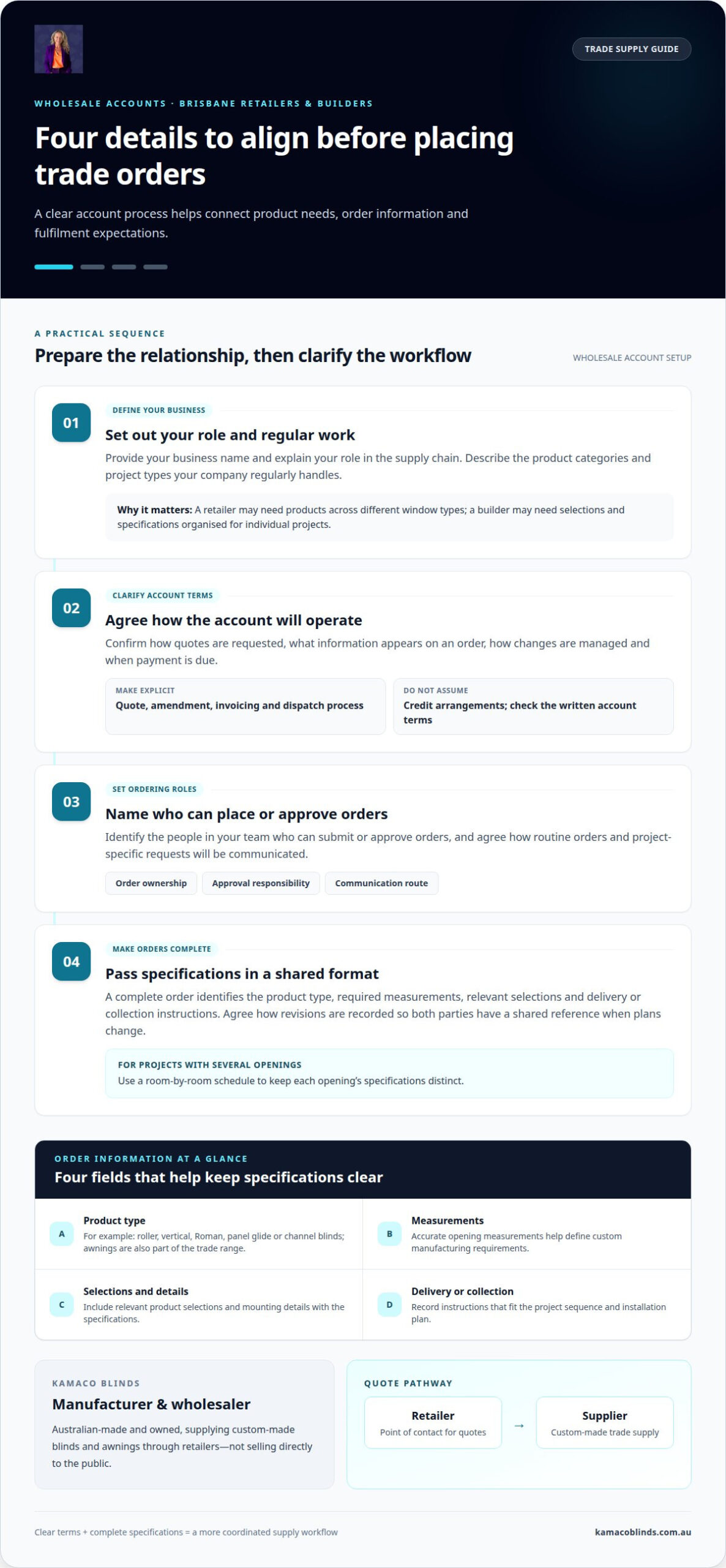
Prepare trade details before applying or opening an account. A practical sequence is:
- Provide your business name and the role your company has in the supply chain.
- Describe the product categories and project types you regularly handle.
- Confirm the process for quotes, order amendments, invoicing and dispatch.
- Identify who in your team can place or approve orders.
Those steps make account conversations more specific. For example, a builder coordinating window furnishings across several rooms can explain how product selections relate to project plans. A retailer can outline how it manages customer selections and subsequent orders. The supplier can then explain how its account process handles those requirements without relying on assumptions.
Order accuracy depends on the details passed between businesses. A complete order should identify the product type, required measurements, relevant selections and delivery or collection instructions. If a project has several openings, a room-by-room schedule can help keep specifications distinct. Agreeing how revisions are recorded also gives both parties a shared reference when plans change.
Assess the account’s practical fit through its everyday workflow. Consider whether your team can obtain quotes, submit complete orders and track fulfilment through a straightforward process. Ask how account communication works for routine orders and project-specific requests. These points matter more than a headline discount if unclear processes create avoidable delays or order corrections.
Finally, match the account arrangement to your business model. A retailer focused on repeat customer orders and a builder coordinating project supply may need different ordering rhythms. A suitable wholesale relationship should make responsibilities, order information and fulfilment steps understandable to everyone involved, from the person selecting products to the team receiving them.
Customer ratings and recommendations
Customer ratings can help retailers and builders assess a supplier, but a score alone says little about trade suitability. Read the review details and consider what the customer actually experienced. A homeowner’s comments about selecting colours, for example, may not describe trade ordering or project requirements.
Look for feedback that describes a specific part of the customer experience. A useful review might explain how clear the product information or communication was, or how an issue was handled. Specific details offer more insight than general praise without context.
Separate comments about products from comments about service. A review focused on appearance may help assess the finished result, while feedback about order accuracy or communication speaks to the business relationship. For a builder, an account of coordinating products across a project may be more relevant than a review about one residential purchase.
Use a simple reading process to make reviews more useful:
- Identify whether the reviewer is a trade customer, builder or household customer.
- Note the product or project context described in the review.
- Look for concrete details about ordering, communication and fulfilment.
- Compare recurring themes rather than relying on one strong or critical comment.
- Consider how the supplier responds when a review raises a concern.
Repeated themes can reveal where a supplier’s process appears consistent. For example, several detailed accounts of clear order communication provide more context than one broad statement. A single complaint also needs context: identify the issue described and whether the response explains a practical resolution. Avoid treating either praise or criticism as a complete picture without supporting detail.
Recommendations from business contacts can offer another perspective. Ask what kind of work the recommendation relates to and which part of the supplier relationship stood out. A retailer might value product selection, while a builder may focus on how requirements were organised. Consider whether the experience matches your own needs.
Use ratings and recommendations as evidence to organise your assessment, not as a substitute for understanding the supply process. Match each comment to a question your business needs answered, such as how orders are communicated or how project requirements are managed. That approach makes feedback more relevant and helps you form a measured view of a potential trade relationship.
Project requirements and product specifications are coordinated across a job to ensure consistent delivery for local trade clients. The scope described in a customer request can also help you judge whether a recommendation is comparable to your commercial needs. For instance, a Brisbane commercial client recently requested an outdoor blind for an alfresco area measuring 2.5 m by 3.5 m, with a height of 3 m (2.5m * 3.5m). Another local project involved short bistro blinds with an approximate drop of 65 cm (65), while a separate multi-unit development required blinds for 11 windows in a residential rental property (11). A local builder working in the area wanted to replace three blinds initially and had seven blinds in total for a renovation (3). Another trade partner requested quotes for two outdoor blinds for a site installation (2). These examples describe different scopes, not service outcomes, so compare recommendations only when the work is relevant to your trade requirements.
Main business location
Eagle Farm is in Brisbane, Queensland, making it a local reference point for trade buyers comparing suppliers. A business location can help frame order coordination, but it doesn’t establish where products are manufactured or how orders are fulfilled. Retailers and builders should distinguish the supplier’s operating address from its production and dispatch arrangements when planning work across Brisbane.
For a Brisbane project, location matters most when it connects with the order’s practical handling. Consider a retailer receiving products for a customer job, or a builder coordinating delivery with other site activity. In each case, the supplier’s location is one part of the plan. Order details, dispatch timing and the nominated delivery or collection arrangement also shape how supply fits the project.
Separate the address question from the fulfilment question. An Eagle Farm location may be useful for identifying a nearby trade business, while delivery coverage and pickup arrangements depend on the supplier’s own process. Treat those as distinct parts of the supply relationship. This avoids assuming that a local address automatically means a particular delivery option or manufacturing turnaround.
A practical location assessment can follow these steps:
- Record the supplier’s business address in your Brisbane trade directory.
- Identify whether the order is intended for delivery to a project or collection.
- Map the order’s handover point against the project schedule.
- Keep dispatch and collection details with the relevant order documentation.
For example, if a builder is coordinating window furnishings with other project materials, the supply plan should make clear where each order is received. A retailer managing customer orders may instead need a consistent process for receiving products before arranging the next stage of fulfilment. In both examples, a clear handover point reduces confusion between the supplier, business and project team.
Location can also help organise internal responsibilities. A Brisbane business might assign one staff member to coordinate supplier communications and another to receive orders. Recording the relevant contact, order reference and delivery or collection instruction together makes the transaction easier to follow. These are useful operational details, not assumptions about the supplier’s opening hours or transport services.
When comparing Eagle Farm businesses, keep the location assessment grounded in information relevant to your trade workflow. Distinguish the business address, manufacturing location and order handover arrangements. Then consider how each detail fits your Brisbane projects, including who receives the order and where it needs to go. This gives retailers and builders a clearer basis for planning supply without treating proximity as a substitute for defined fulfilment arrangements.
Which trade blinds suppliers are located in Eagle Farm, Queensland?
For Eagle Farm trade supply, distinguish a supplier’s business address from its manufacturing site and delivery arrangements. Those details describe different parts of the relationship. A business may operate locally while production or order fulfilment follows a separate process, so an address alone doesn’t identify the complete supply arrangement.
Retailers and builders can compare suppliers by the work each business performs. A manufacturer produces window furnishings, while a wholesaler supplies products to trade customers. Kamaco Blinds manufactures and wholesales blinds and awnings for retailers.
Use a short comparison record to make the local options clearer:
- Write down each business name and its Eagle Farm address.
- Record whether it manufactures, wholesales or performs both functions.
- Note which indoor blind and awning categories suit your projects.
- Separate the business location from production and dispatch details.
- Track how trade orders and fulfilment are handled.
This distinction matters for a builder planning a Brisbane project. A nearby supplier may simplify communication, but project coordination also depends on accurate specifications and an understood handover process. A retailer serving customers across Brisbane may place greater weight on product range and repeat ordering. The relevant supplier is the one whose trade model fits the work.
Recommendations can help narrow your assessment, but connect each recommendation to a specific business and service. For example, feedback about a local showroom doesn’t necessarily explain wholesale ordering or manufacturing. A useful reference describes the kind of customer, product requirements and supply experience involved. That context makes comparisons more meaningful.
Before settling on a trade relationship, map the order journey from product selection to receipt. Identify which business receives the specifications, which role handles production and where the order is handed over. For a multi-room project, clear product schedules can help keep selections associated with the right openings. These steps make the supplier’s role easier to assess without assuming every Eagle Farm business works the same way.
Choose based on the fit between your trade requirements and the supplier’s actual role, product categories and order process. A local address is a useful starting point, not a complete measure of suitability. Retailers and builders looking for an Australian-made and owned trade blinds business can explore trade blind supply as part of their Eagle Farm comparison.
Kamaco Blinds
Kamaco Blinds is an Australian-made and owned manufacturer and wholesaler of blinds and awnings for retailers. Its range includes Roller blinds, Vertical blinds, Veue drop awnings and Zipscreen, alongside Roman blinds and Panel glide blinds.
For a trade enquiry, prepare the product category and relevant project specifications. Clear details help focus the discussion on suitable products, whether you’re sourcing for a retail customer or a building project. Kamaco Blinds uses Rollease Acmeda® components in its products for smooth, hassle-free operation.
If you’re assessing trade supply options for your business, contact Kamaco Blinds to discuss your requirements.
Choose a trade partner for your next project
Your next step is to match your product requirements with a supplier whose trade range suits your work. Choosing a trade blinds supplier in Eagle Farm is about finding a practical fit for your Brisbane business, not simply selecting a nearby name. Consider the project types you serve and the window furnishing categories your customers need.
Kamaco Blinds manufactures and wholesales products including Zipscreen™, Veue Drop Awnings and Roller Blinds. For retailers and builders, that range offers a starting point for discussing supply needs across indoor and outdoor applications. Share the product categories and project context that matter to your business to make the conversation focused and useful.
When you’re ready to discuss trade supply for your business, Contact Kamaco Blinds today. A clear conversation can help you take the next step with confidence.
Frequently Asked Questions
Which suppliers offer wholesale or trade pricing for blinds near Eagle Farm?
Kamaco Blinds manufactures and wholesales blinds and awnings for retailers and trade professionals in Brisbane. Trade supply is retailer-focused, so the quote route is through a retailer rather than direct public retail sales. To be connected with a retailer near you, leave your details at in**@**************om.au, then request a quote from one of the retailers. This gives trade buyers a route to discuss product and project requirements.
What are the minimum order quantities and trade account requirements?
Kamaco Blinds’ trade supply is arranged through retailers, and no general minimum quantity applies across every order. The relevant retailer can discuss order requirements in relation to the products and project. For a quote, prepare your business details, product categories and order specifications, then request a quote from one of the retailers. Retailers can leave their details at in**@**************om.au to be connected with the trade supply process.
What are the lead times for made-to-measure blinds from local suppliers?
Lead times for made-to-measure blinds depend on the product selection and the specifications supplied for the order. A Brisbane retailer can discuss timing against the project requirements as part of the quote process. Include the relevant product category, measurements and any motorisation or box system requirements when describing the order. Kamaco Blinds supplies custom-made products through retailers, who are the point of contact for quotes.
What are the best-rated trade blinds suppliers near Eagle Farm?
The best-rated option depends on current, comparable customer feedback, especially reviews from trade buyers describing relevant orders. Look for comments that explain the reviewer’s project and experience, rather than relying on a rating alone. For Brisbane trade supply, Kamaco Blinds manufactures and wholesales blinds and awnings through retailers. Retailers can provide a quote for the products and project needs you outline, helping you assess fit alongside customer feedback.