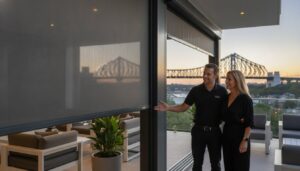
The right blinds can bring a Brisbane interior scheme together while balancing light, privacy and everyday function. For interior designers planning trade projects, blinds for interior designers’ trade projects in Brisbane should suit each window opening and the room’s materials, colours and use.
Choosing a style is only part of the process. Fabric, light control and how a blind works with nearby doors or furnishings all influence the result, so consider these details alongside the overall design.
This guide explores roller blind options and other indoor styles, plus how showroom consultations and fabric samples can help shape a considered selection. You’ll also learn what to consider when choosing a Brisbane blinds professional and how service areas may include Brisbane, Ipswich, Logan and the Gold Coast.
Key Takeaways
- Plan blind selection around each room’s light, privacy and design needs, as well as the dimensions of its window openings.
- Use fabric samples to assess colour and texture in the space, and consider how light-filtering or blockout fabrics suit different rooms.
- Match the blind style to the opening: panel glide blinds can suit broad windows and sliding or French doors.
- Consider how a local professional’s product range and service coverage align with your project location and design brief.
- Explore roller blinds and other suitable window-covering options to create a cohesive finish across residential or commercial spaces.
Looking for indoor blinds in Brisbane?
Brisbane projects may involve one bedroom window, a full home or a commercial fit-out. The right selection depends on the opening, room use, light control and desired finish.
Residential and Commercial Blind Installation
Residential projects often need a consistent look across bedrooms, living areas and connected spaces. Commercial projects may involve different window sizes, room functions and design requirements within one site. Document each opening and note nearby doors, furnishings and architectural details. A large glazed area, for example, may need a different treatment from a compact bedroom window.
Plan the window coverings by identifying each room and its intended use. Separate indoor spaces from outdoor openings, then record the treatment and finish for each. This gives the project team a clear basis for coordinating window coverings with other interior elements.
Brisbane Measuring, Quotes and Installation
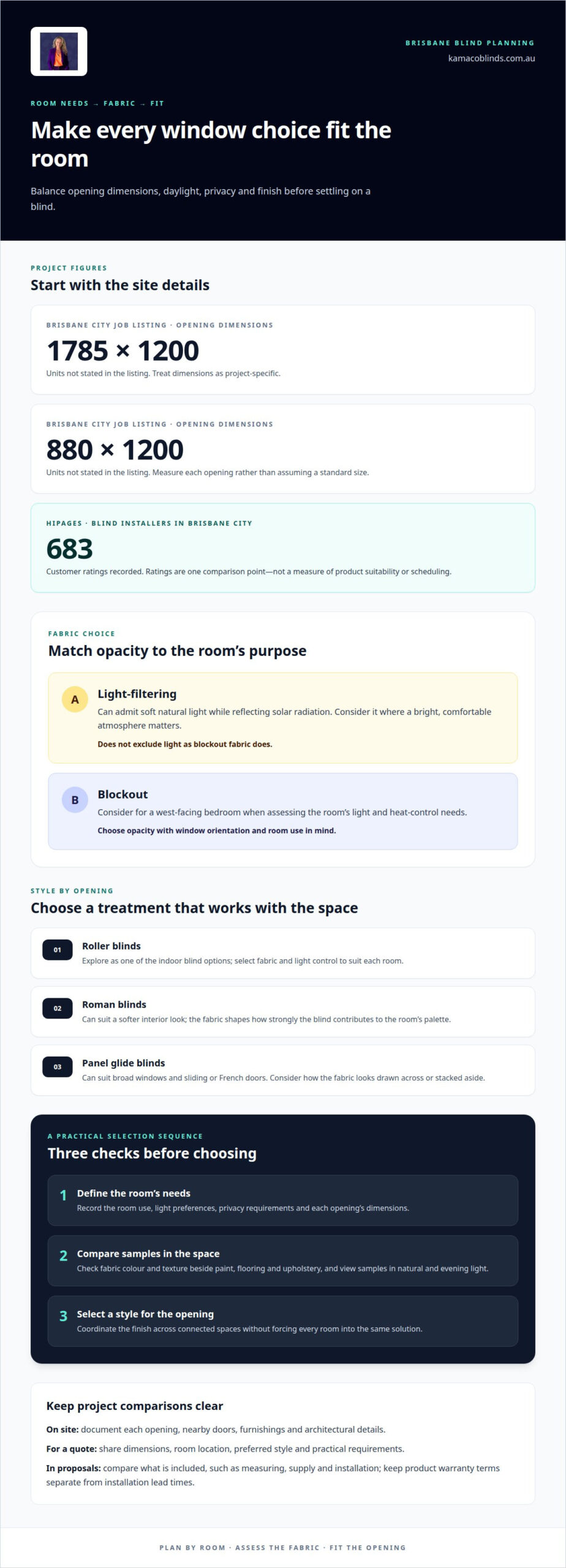
Accurate measurements matter because a blind must suit the opening and its surrounding space. Brisbane City job listings show opening dimensions of 1785×1200 and 880×1200; the listings do not state a unit. Treat dimensions as project-specific rather than assuming every opening follows a standard size. A measure, quote and installation service can connect site details with product selection and fitting.
For a quote, organise the opening dimensions, room location and preferred style. Note practical requirements, such as privacy or filtered daylight, alongside the design brief. Before accepting a proposal, distinguish product warranty terms from installation lead times. These are separate details: warranty information concerns the product or work covered, while lead times relate to project scheduling.
Supplier Listings and Service Comparisons
Brisbane City installer listings can help identify businesses handling local blind jobs. Hipages records 683 customer ratings for blind installers in Brisbane City. Ratings offer one comparison point, but they don’t explain product suitability, customisation or project scheduling. Compare written proposals by checking what each includes, such as measuring, supply and installation.
How do Brisbane blind suppliers compare on lead times, product range and customisation? Lead times depend on the product and project schedule, while range and customisation vary by supplier. Compare these details in each written proposal, including available finishes and how the supplier handles different opening dimensions. Don’t assume that a broad range means every option suits every room.
Trade Accounts for Interior Designers
Which Brisbane blind suppliers offer trade accounts for interior designers? Trade accounts are supplier-specific, so designers should approach suppliers with a trade program and use its application process. Before applying, clarify the account terms, ordering method, product range and how quotes are prepared. These details help establish whether the arrangement suits the designer’s workflow and project type.
For blinds for interior designers’ trade projects in Brisbane, keep project requirements clear from the first enquiry. Share the room schedule, opening details and preferred finishes through the supplier’s stated trade channel. This creates a practical starting point for discussing product selection, customisation and the next steps for the project.
Showroom consultations and fabric samples
A showroom consultation can help translate a room’s design brief into practical fabric and colour choices. Samples make it easier to assess how a material works with the space before selecting a style.
For an interior scheme, consider appearance and function together. A fabric that complements the wall colour should also suit the room’s light needs, privacy requirements and intended use.
Material, Fabric and Colour Selection
Start with the room palette, then compare fabrics against nearby paint, flooring and upholstery. A neutral fabric can create continuity across connected rooms, while a contrasting colour can make a window treatment a deliberate feature. View samples beside the materials they need to coordinate with.
Assess texture as well as colour. A smooth fabric can support a restrained, contemporary scheme; a more visible weave may add warmth and depth. Check samples in the room’s natural light, because the same colour can appear different beside a north-facing window or under evening lighting.
For a project discussion, bring a schedule that identifies each room, preferred style and functional priorities. This helps keep choices consistent without forcing every space into the same solution. Roman blinds, for example, can suit a softer interior look, while the fabric determines how prominently the blind contributes to the room’s palette.
Light-Filtering and Blockout Fabrics
Match fabric opacity to the room’s purpose. Light-filtering fabrics in living areas can admit soft natural light while reflecting solar radiation. They suit spaces where a bright, comfortable atmosphere matters, although they don’t provide the same light exclusion as blockout fabric.
For a west-facing bedroom, consider whether blockout fabric suits the room’s light and heat-control needs. Consider the window’s orientation and the room’s use before settling on an opacity. A bedroom and a shared living space may need different choices, even within one home.
Panel glide fabrics also affect the balance between daylight and privacy across broad openings. Consider how the fabric will look when the panels are drawn across the window and when they’re stacked aside. In a connected living and dining area, a coordinated tone can keep the scheme cohesive while serving distinct openings.
A useful selection sequence is to define the room’s light needs, compare fabric samples against its finishes, then choose a style that supports the overall scheme. Explore roller blind fabric options as part of that design process, considering colour and light control together.
Window-covering services in Brisbane, Ipswich, Logan and the Gold Coast
Interior projects across Brisbane, Ipswich, Logan and the Gold Coast can involve varied window sizes, layouts and design briefs. When partnering with Kamaco Blinds for wholesale supply, map each opening and room function before selecting a covering.
Service Area Coverage
For a project spanning Brisbane, Ipswich, Logan and the Gold Coast, organise window schedules by address and room. This helps keep product choices, finish references and project documents aligned across separate sites. Record whether each opening faces a living area, bedroom, workspace or shared commercial setting.
Regional planning also helps designers coordinate related decisions. A living room with broad glazing may need a different treatment from a compact office window, even when both spaces share the same colour palette. Note the opening type, adjoining doors and preferred level of light control in each project schedule.
For multi-site work, use consistent labels for rooms and finishes. For example, a project code paired with “meeting room” or “main bedroom” makes sample decisions easier to track. Keep separate notes where a building’s layout or orientation calls for a different fabric or style.
Brisbane Window-Treatment Professionals
Brisbane window-covering projects benefit from a clear product specification. Useful details include opening dimensions, room use, privacy needs, preferred appearance and nearby door or furniture constraints. These details provide a clear basis for discussing suitable trade options with Kamaco Blinds.
Consider how the covering relates to the whole interior. Vertical blinds may suit a design where adjustable coverage across a window or glazed door is important. For a broad sliding or French door opening, panel glide blinds can cover large openings while providing a coordinated finish.
Keep the product decision distinct from the installation scope. A product specification identifies the treatment and its intended fit; installation arrangements are a separate project consideration handled outside the trade supply scope.
Window Furnishing Product Range
A considered product range lets designers match the window treatment to each opening and interior style. Vertical blinds offer a different visual line from Roman blinds, while roller blinds create a simpler fabric plane. Panel glide blinds can suit larger windows and sliding or French doors. Compare the appearance and operation required for each space.
Curtains may also form part of a room’s overall window-covering design, but they create a different layered effect from blinds. Specify whether the brief calls for a soft textile finish, a streamlined blind or a combination of treatments. That clarity helps align the selection with the room’s proportions, palette and intended function.
Before finalising a schedule, group openings by size, use and preferred treatment. Then note exceptions, such as a large glazed door needing panel coverage while nearby windows use another style. This gives each decision a clear design purpose across Brisbane, Ipswich, Logan and the Gold Coast.
Choosing a local professional
A well-planned Queensland project distinguishes product supply from measuring and installation. These can be separate parts of a window-treatment project, so define which responsibilities belong in the designer’s scope and which sit with the supplier or installer.
Begin with the project brief. Record each room, window type, design intent and functional requirement. A bedroom may call for blockout fabric, while an indoor living area may need filtered daylight. Include relevant finishes, such as wall colour, flooring and nearby furniture, so product discussions stay connected to the finished scheme.
Review product information against the brief. The supplier’s range should offer suitable choices for the project’s openings and visual style. A treatment selected for a broad glazed area, for example, may differ from one chosen for a smaller bedroom window. Confirm the product category, available finishes and customisation details in the written specification.
Use a practical comparison checklist:
- Project fit: Does the proposed range suit the room functions and opening types?
- Specification: Are product, fabric, colour and operation clearly identified?
- Scope: Does the proposal distinguish supply from measuring and installation?
- Scheduling: Are lead-time details relevant to the project’s sequence?
- Documentation: Are warranty terms and order details recorded clearly?
These points help interior designers assess proposals without judging a product by appearance alone. A beautiful colour may suit the palette, but the fabric’s light-control role still needs to match the room. Likewise, a suitable product category can be undermined by an unclear specification or a schedule that does not align with other trades.
For a residential project, compare the bedroom, living room and adjoining openings as a coordinated set. For a commercial fit-out, organise the schedule by room name and window type. In both cases, consistent labels reduce confusion as the design moves from selection to ordering.
Trade designers should also consider how the supplier supports a wholesale relationship. Clear ordering information, product specifications and defined responsibilities help integrate window coverings into a broader project workflow. Keep the latest schedule with the design documentation, and record changes to fabrics, colours or opening details before finalising the order.
Local knowledge is useful when it relates a Queensland project’s conditions to the design brief. The decision should still rest on the documented product, scope and schedule. A disciplined selection process keeps aesthetic choices and practical requirements aligned, from the first specification through to the completed interior.
Which Brisbane blind suppliers offer trade accounts for interior designers?
Trade accounts are supplier-specific, so Brisbane designers should shortlist businesses that explicitly provide a trade application pathway. A supplier’s general wholesale offering and a designer trade account aren’t automatically the same arrangement. Review the account terms before relying on them for project ordering.
Start with suppliers whose product ranges fit your current work. Then assess whether their ordering process supports the way you specify, quote and order window coverings. A useful comparison focuses on the documented process, not an assumed discount or benefit.
Review these points for each potential supplier:
- Eligibility: What business or design details does the application request?
- Product access: Which blind categories, fabrics and finishes are covered?
- Quoting: How are project specifications and quote requests submitted?
- Ordering: What information is needed to place or amend an order?
- Account terms: How are payment, account use and trade conditions explained?
Keep the comparison tied to an actual project. For example, a residential schedule might include bedroom treatments and living-area window coverings, while a commercial brief could involve multiple room types. Check whether the supplier’s stated product range aligns with those needs before completing an application.
How can an interior designer apply for a blind supplier trade account in Brisbane? Use the supplier’s trade application or enquiry process, provide the requested professional and business details, then review the account terms before placing project orders. Prepare a concise introduction to your practice and the types of projects you handle, so the application has relevant context.
Account terms matter as much as the application itself. Read how the supplier handles quotes, order changes, payment conditions and product information. Avoid assuming that trade status includes a particular price, sample service or project support unless the written terms describe it.
For blinds for interior designers’ trade projects in Brisbane, a clear account process can make product specification and ordering easier to organise. Keep the supplier’s terms with your project records, and note any account conditions that affect how you prepare quotes or manage client approvals. That way, each project’s product selection remains connected to its commercial arrangements.
To explore blind options for a trade project, review window-covering options alongside your design brief and project schedule.
Kamaco Blinds
Kamaco Blinds helps interior designers source window coverings for projects where product range, finish and function need to work together. As an Australian-made and owned manufacturer and wholesaler, it offers Roller blinds, Vertical blinds, Zipscreen and Veue drop awnings.
For a Brisbane design brief, consider which openings need indoor blinds and which call for an outdoor awning. Share the project requirements and preferred look to guide product selection. Kamaco Blinds uses Rollease Acmeda® components across its products for smooth, hassle-free operation.
If you’re developing a project specification or considering window-covering options, contact Kamaco Blinds to discuss your requirements.
Move your Brisbane project forward
A considered window-covering specification can help preserve the design intent as a project moves from concept to ordering. For blinds for interior designers’ trade projects in Brisbane, bring the room schedule, opening details and finish preferences together before discussing product options. This gives the conversation a clear starting point and connects each selection with the space it’s intended for.
Kamaco Blinds manufactures and wholesales window coverings, giving design professionals a product-focused point of contact for project discussions. Share the brief and the requirements shaping your choices, from visual direction to the function each room needs. The next step can be a focused conversation about options that suit your design scheme.
Contact Kamaco Blinds to discuss your project requirements and take the next step with confidence.
Frequently Asked Questions
What are the different types of blinds?
Common blind types include roller, vertical, Roman, panel glide, Venetian and channel blinds. Each creates a different look and suits different window layouts. For example, panel glide blinds can cover broad openings, while Roman blinds bring a softer fabric look. Kamaco Blinds’ wholesale range includes roller, vertical, Roman, panel glide and channel blinds, giving trade professionals several styles to consider for a project.
Who is This Service For?
Kamaco Blinds’ wholesale service is for retailers and trade professionals in the window furnishing industry, including interior designers sourcing products for projects. It isn’t a direct-to-public retail service. Designers can request a quote from one of Kamaco Blinds’ retailers and arrange product supply for a project. For example, a designer preparing a residential specification can identify the required blind types and discuss those selections through a retailer.
What types of blinds are available wholesale or trade in Brisbane?
Kamaco Blinds wholesales custom-made roller, vertical, Roman, panel glide and channel blinds, alongside Zipscreen and Veue drop awnings. This gives Brisbane trade professionals indoor and outdoor window-covering categories to consider across project schedules. A designer may specify different blind styles for separate rooms, then discuss product selection through a retailer. The range also includes motorisation and box systems.
Which Brisbane blind suppliers provide fabric samples, swatches and product catalogues to designers?
Fabric samples, swatches and catalogue arrangements depend on the supplier’s trade process. Kamaco Blinds supplies retailers, who are the point of contact for quotes and product enquiries. To be connected with a retailer near you, leave your details at in**@**************om.au. Include your project type and the blind categories you’re considering, such as Roman or roller blinds, to give the enquiry useful context.
Do Brisbane blind suppliers offer measuring, quoting and installation services for trade customers?
Kamaco Blinds provides wholesale custom-made blinds, while retailers are the contact point for quotes. Measuring and installation are separate project requirements, so define them clearly within the trade brief. Request a quote from one of Kamaco Blinds’ retailers and provide the relevant product choices and project details. Kamaco Blinds’ role is manufacturing and wholesale supply; installation arrangements are separate.
Which Brisbane suppliers offer motorised blinds and smart-home integration for trade projects?
Kamaco Blinds offers motorisation and box systems for its products, including Automate™. Motorised operation and smart-home integration are distinct specifications, so state each requirement separately in a trade brief rather than assuming one includes the other. For Brisbane projects requiring motorisation, request a quote from one of Kamaco Blinds’ retailers. This retailer-led process connects product selection with the project’s trade requirements.