A smooth blinds order starts with a clear customer brief. The blind ordering process for retailers is easier to manage when the brief captures the customer’s priorities, preferred product category and any custom requirements. This gives you a useful foundation for discussing product options and preparing a focused quote request.
This guide takes you from shaping the brief to requesting a quote through Kamaco Blinds’ retailer pathway. You’ll find practical ways to record customer preferences, identify relevant products and note service requests. Kamaco Blinds is an Australian-made and owned manufacturer and wholesaler serving retailers and trade professionals, with custom-made blinds and a trade-focused support team. For Brisbane retailers, the steps below help keep the customer conversation connected to the quote process.
Key Takeaways
- Use a clear customer brief to connect product selection, custom requirements and quote requests.
- Follow a practical blind ordering process for retailers: capture the brief, identify a product category, note relevant services and request a quote.
- Compare retailer-mediated manufacturer supply with online consumer purchasing by considering who guides the customer and manages the quote.
- Prepare the customer’s priorities, preferred product category and service requests before progressing the quote.
- Kamaco Blinds is an Australian-made and owned manufacturer and wholesaler, with retailers as the point of contact for quotes.
Why a clear blind ordering process matters for retailers
A customer may know how they want a room to feel, but translating that goal into a supplier request takes a focused conversation. They might prioritise privacy, appearance or a particular product category. A clear blind ordering process for retailers helps turn those preferences into information that can guide product selection and the quote discussion.
That clarity matters in a trade relationship. A retailer guides the customer, develops the brief and remains the point of contact for the quote. This differs from a homeowner purchasing blinds online for themselves. The retailer’s role is to represent the customer’s requirements accurately and keep communication consistent as the brief moves towards a quote.
For a broader foundation, Supply Chain Management explores how connected decisions and communication support the movement of goods through a supply chain. The same principle applies to a retail order: a well-formed request helps the next person understand what the customer is looking for.
To see a sample-ordering demonstration, watch this video:
Where retailer blind orders can become unclear
A brief can be too vague if it names a room but not the customer’s priorities. For example, “wants a blind for the living room” does not explain whether privacy, appearance or a particular product category matters most. Ask what the customer wants the window covering to do, what style they prefer and whether they have a category in mind. Record the answers in plain language so you can discuss suitable options without relying on assumptions later.
What a trade-focused ordering journey should achieve
A useful workflow moves from a clear customer brief to a considered product choice, then to a retailer quote request. Each step should add information that helps the next conversation. Kamaco Blinds’ trade-focused service and responsive local support team serve retailers working with an Australian-made and owned manufacturer and wholesaler.
An effective retailer ordering process turns the customer’s priorities into a clear product and service brief for a focused quote request. The aim is to make the request easier to understand and discuss, while allowing the retailer to tailor the conversation to the customer’s project.
How retailers can move a blind order from customer brief to quote
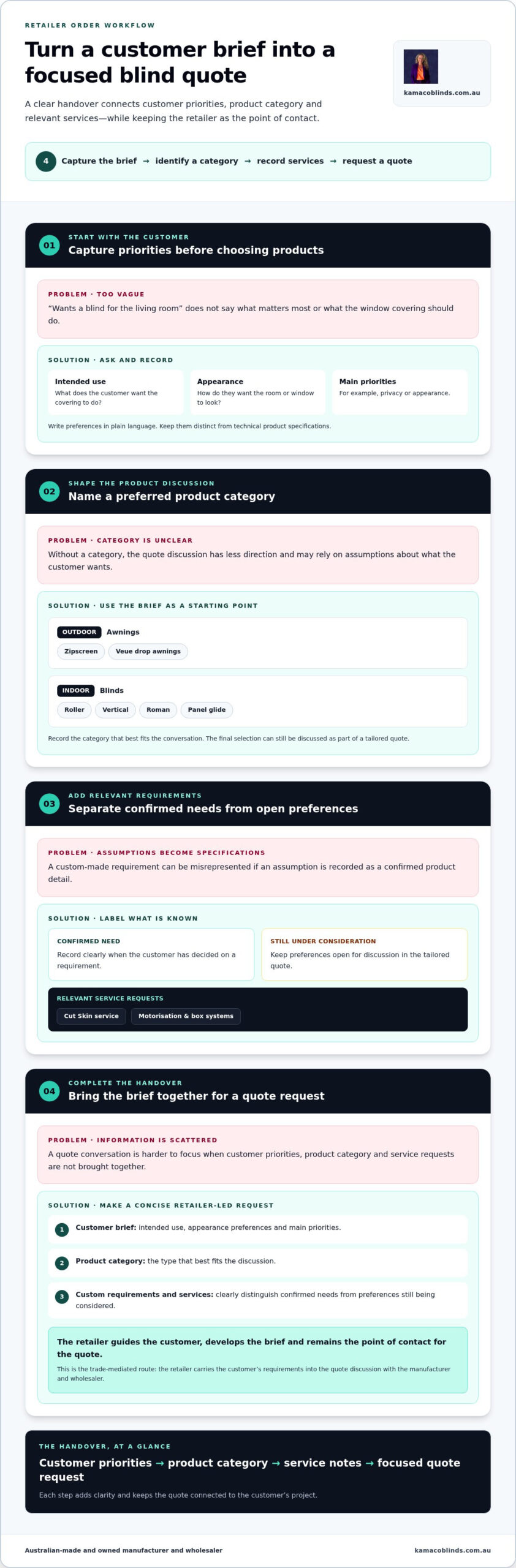
A consistent handover helps turn a customer’s ideas into a focused request without treating every project as identical. Use this sequence to organise the conversation: the customer’s priorities guide the product discussion, and you carry the resulting brief into a quote request.
Build a useful customer brief before choosing products
Start with what the customer wants the window covering to do and how they want it to look. Note the intended use, preferred product category and main priorities in clear, everyday language. Keep customer preferences distinct from technical product specifications. The brief records the customer’s direction, while project-specific details can be discussed as part of a tailored retailer quote request.
Then identify the category that best reflects the conversation. Kamaco’s range includes Zipscreen and Veue drop awnings, as well as indoor options such as Roller blinds, Vertical blinds, Roman blinds and Panel glide blinds. Naming the preferred category gives the quote request a useful starting point, even if the final selection needs further discussion.
Turn the brief into a quote request
Once you’ve captured the customer’s priorities and product category, summarise them in a concise request. Include relevant custom-made requirements and requested services, distinguishing confirmed needs from preferences still under consideration. This gives the retailer a clear basis for discussing the project and helps keep the quote conversation focused on the customer’s brief.
- Capture the brief. Record the customer’s intended use, appearance preferences and main priorities.
- Identify a category. Note the product type that best fits the discussion, such as a Roller blind, Roman blind or Zipscreen.
- Record requested services. Where relevant, note a request for Kamaco’s Cut Skin service or Motorisation & box systems.
- Request a quote. Bring the customer brief, chosen category and relevant service request together for a retailer-led quote discussion.
Keep the language direct. If the customer has a particular custom-made requirement, describe it plainly rather than turning an assumption into a product specification. You can distinguish what the customer has decided from what still needs to be discussed as part of the tailored quote. This is especially useful when the customer is weighing up product categories or service options.
A clear handover turns the customer’s priorities into a product-focused brief that the retailer can use to request a tailored quote. That is the practical centre of the blind ordering process for retailers: each step adds clarity and keeps the quote connected to the customer’s project.
For Brisbane retailers, the local trade pathway gives the customer a clear point of contact for discussing their project. Leave your details at in**@**************om.au to be contacted by a retailer near you, then request a quote from one of Kamaco’s retailers. You can also explore the Kamaco Blinds retailer pathway.
How to compare blind ordering routes for a retail business
The right order pathway depends on who serves the customer and how the purchase is managed. A homeowner buying blinds online follows a consumer purchasing journey. A retailer working with a manufacturer follows a trade-mediated route, where the retailer develops the customer brief and acts as the point of contact for the quote. Compare these approaches by how well they fit your business and the way you support customers.
Retailer-mediated supply versus online consumer purchasing
In a retailer-mediated journey, you guide the product discussion, gather the customer’s priorities and take the quote request forward. Kamaco Blinds’ model keeps retailers as the point of contact for quotes. By contrast, consumer online guides focus on individuals choosing and purchasing blinds for their own homes. The useful distinction is who manages the customer relationship and shapes the request.
Route: Retailer-mediated manufacturer supply
Who manages the customer relationship: The retailer remains the customer’s contact and progresses the quote request.
What the retailer should consider: Whether the route supports trade-focused communication and a customer-specific, custom-made brief.
Route: Consumer online purchasing
Who manages the customer relationship: The consumer manages their own product selection and online purchasing journey.
What the retailer should consider: Whether a consumer-led process fits the retailer’s role in advising and coordinating customer requirements.
What to weigh when selecting an order pathway
Start with your intended role. If your business leads product selection and communicates project requirements, choose a pathway that keeps those conversations connected to the quote request. Consider how clearly custom-made requirements can be represented and whether trade-focused communication suits the way you serve customers. These are practical criteria for comparing routes without assuming one is faster or less costly.
Manufacturer-direct supply gives retailers a direct trade relationship with the manufacturer, while responsive local support offers a local point of assistance. Kamaco Blinds is an Australian-made and owned manufacturer and wholesaler serving retailers and trade professionals. Its retailer-mediated quote pathway keeps the retailer central to the customer conversation, with the project brief forming the basis of the request.
The Wholesale Blinds Australia: The Retailer’s Guide to Brisbane Manufacturing article offers a broader perspective on wholesale supply and local manufacturing. Use that context alongside your own business model: a retailer guiding customers through product choices may value a trade-focused relationship, while a consumer purchasing online may prefer to manage their own selection journey.
In practice, compare routes by asking who develops the brief, who communicates with the customer and how project-specific requirements reach the quote stage. These questions give your business a grounded basis for choosing an ordering pathway, without relying on assumptions about margins, delivery speed, minimum orders or operational savings. A clear fit supports a consistent customer experience and a considered trade request.
What retailers should prepare for a custom blind order
A well-prepared brief keeps the customer’s priorities visible while you narrow down a product category and relevant service requests. For a custom blind order, focus on what the customer wants, which type of covering they’re considering and what they’d like included in the quote discussion. Keep preferences separate from assumed specifications so the conversation stays clear.
Match the customer brief to a confirmed product category
First, distinguish between outdoor options and indoor blinds. The range includes Zipscreen and Veue drop awnings, alongside Roller blinds, Vertical blinds, Roman blinds and Panel glide blinds. Zipscreen provides privacy, year-round protection and protection from the elements and insects. Use the customer’s priorities to guide the category discussion rather than assuming one option suits every project.
For additional context on choosing window coverings for local homes, the article How to Choose the Perfect Blinds for Brisbane Homes: A Complete 2026 Guide explores the customer-facing decision. In your trade brief, focus on the customer’s preferred category and the reasons behind that preference.
Record customisation and service requests clearly
When a customer wants a custom-made blind, describe the request in straightforward terms and separate their preferences from product specifications that need to be discussed through a tailored quote. Include a service request when it relates to the brief. Kamaco’s services include Cut Skin service and Motorisation & box systems. For customers considering motorisation, the article Smart Home Motorised Blinds Brisbane Wholesale: 2026 Trend Analysis provides further context for that discussion.
A concise checklist can help you gather the information without creating unnecessary steps or implying that every project needs the same details:
- Customer priorities: Note the intended use, preferred appearance and the main outcome the customer wants from the window covering.
- Product category: Record whether they’re considering Zipscreen, Veue drop awnings, Roller blinds, Vertical blinds, Roman blinds or Panel glide blinds.
- Custom-made request: Summarise project-specific preferences clearly, without treating them as confirmed technical specifications.
- Requested service: Include Cut Skin service or Motorisation & box systems when relevant to the customer’s brief.
- Quote discussion: Bring the priorities, selected category and relevant requests together so the retailer can carry them into a quote request.
This preparation supports a more considered blind ordering process for retailers: the customer’s needs remain central, and the quote request has a clear foundation. The retailer remains the point of contact for quotes through Kamaco’s trade-focused pathway.
To progress a customer-specific brief, request a quote through a Kamaco retailer. Leave your details at in**@**************om.au to be contacted by a retailer near you.
How the Kamaco Blinds retailer quote pathway works
Kamaco Blinds is an Australian-made and owned manufacturer and wholesaler serving retailers and trade professionals. Its quote pathway is retailer-mediated: retailers are the point of contact for quotes. Retailers carry customer requirements forward, from the initial product discussion to a request for a quote.
For Brisbane retailers, this means the customer’s brief becomes part of a trade-focused conversation rather than a direct-to-public purchase. The retailer remains involved in communicating the project, while Kamaco provides the manufacturing and wholesale relationship behind the request. Leave your details at in**@**************om.au to be contacted by a retailer near you, then request a quote from one of Kamaco’s retailers.
What retailers can expect from a trade-focused supplier
A trade-focused relationship includes more than product selection. Kamaco manufactures custom-made blinds and offers Cut Skin service and Motorisation & box systems. Retailers can include relevant service requests in the brief so the quote discussion reflects the customer’s project.
All products use Rollease Acmeda® components for smooth, hassle-free operation. Retailers can share this confirmed product information without adding technical assumptions to the customer conversation. Focus the brief on the product category and project needs, with Kamaco’s responsive local support team available to support retailers and trade professionals.
A clear blind ordering process for retailers brings these elements together: a customer-specific brief, a relevant product and service request, and a quote conversation managed through the retailer. This keeps communication focused and gives retailers a practical way to represent what the customer needs while maintaining their role in the trade relationship.
Take the next step with a retailer quote
To be connected with a retailer near you, leave your details at in**@**************om.au. Then request a quote from one of Kamaco’s retailers. This gives you a retailer contact for discussing the customer’s brief and relevant product or service requirements.
For retailers, a clear pathway provides practical direction: prepare the customer requirements, connect with a retailer and progress the quote through the trade relationship. Request a quote from one of Kamaco’s retailers to take the next step.
Make your next retailer order a confident step forward
Every customer brief is an opportunity to build a trade relationship around clear communication and considered product choices. Let the customer’s priorities guide your conversation, then carry those requirements into a retailer quote request. A consistent blind ordering process for retailers helps your business support each project from the first discussion through to the quote.
Kamaco Blinds brings an Australian-made and owned manufacturing perspective to its retailer relationships. Its products use Rollease Acmeda® components, and its responsive local support team serves retailers and trade professionals. These qualities provide a foundation for a supply relationship that fits the way you serve customers.
Take the next step with a retailer quote. Request a quote from one of our retailers and move your customer’s project towards a tailored discussion. Prepare a clear brief, leave your details at in**@**************om.au to be contacted by a retailer near you, and progress the quote through the trade pathway.
Frequently Asked Questions
Who should a retailer contact to request a Kamaco Blinds quote?
Retailers request quotes through a Kamaco Blinds retailer, who remains the point of contact for the quote discussion. Leave your details at in**@**************om.au to be contacted by a retailer near you. Once connected, share the project brief and request a quote from one of Kamaco’s retailers. This gives Brisbane trade businesses a clear contact for progressing a customer’s window furnishing requirements.
Can retailers request custom-made blinds from Kamaco?
Yes. Kamaco manufactures custom-made blinds and awnings for retailers. If a customer needs a made-to-order solution, describe the project’s priorities and preferred product category in your retailer brief. Use the retailer quote request to bring the customer’s requirements into a tailored trade conversation.
What is Kamaco Blinds’ Cut Skin service?
Cut Skin service is provided by Kamaco for retailer clients. Retailers can include it as a requested service when it is relevant to a customer’s project. Label the request clearly so it is easy to distinguish from the customer’s chosen blind category.
Does Kamaco Blinds offer motorisation and box systems?
Yes. Motorisation & box systems are among Kamaco Blinds’ services for its products. Retailers can note this service in a quote request when it relates to the customer’s brief. For Brisbane retailers, include the service request with the product requirements when discussing a quote through a retailer.
Which components do Kamaco blinds use?
All Kamaco products use Rollease Acmeda® components for smooth, hassle-free operation. Retailers can share this information when explaining the product range to customers. If a customer asks how a particular product is configured, keep the discussion focused on the selected category and project requirements through the retailer quote pathway.
How much does a retailer order from Kamaco Blinds cost?
Retailer order pricing is discussed through a quote from one of Kamaco’s retailers. To progress a Brisbane project, prepare the customer’s requirements and use the retailer-mediated pathway to request a tailored quote.
Can homeowners request a quote directly from Kamaco Blinds?
Customers can leave their details at in**@**************om.au to be contacted by a retailer near them. The retailer is the point of contact for the quote, so homeowners can discuss their window furnishing requirements with that retailer and request a quote from one of Kamaco’s retailers. This connects the customer with the trade pathway while keeping the quote discussion retailer-led.