
What if the difference between a thriving retail season and a margin-crushing quarter was found in a single millimetre? For a busy retailer, that tiny discrepancy often translates into the high cost of re-ordering custom skins or managing negative reviews from poorly tracking blinds. You understand the pressure of delivering a flawless finish, yet technical confusion over motorised limit settings or slight measuring errors can quickly erode your hard-earned profits.
This guide helps you master the technical nuances of professional installation to eliminate costly re-orders and protect your retail margins. We’ll examine the common blind installation mistakes for retailers to avoid in 2026, including navigating the latest ANSI/WCMA cordless safety standards and the intricacies of new “Absolute Silence” motorisation. You’ll learn how a zero-defect installation process leads to higher customer satisfaction and referrals. We’ll preview the best practices for installing Brisbane-made Zipscreen and Veue drop awnings, ensuring your business remains a trusted guide for homeowners seeking both elegance and engineering excellence.
Key Takeaways
- Understand how precise installation prevents the “call-back” cycle and ensures every sale contributes fully to your bottom line.
- Learn the “Triple-Check” protocol and deduction nuances to eliminate the common blind installation mistakes for retailers to avoid during the measuring phase.
- Master the alignment and tensioning techniques for Zipscreen™ and Automate™ systems to deliver a smooth, wind-resistant finish every time.
- Identify the correct fixings for various substrates like masonry or Hebel to guarantee the long-term structural integrity of heavy-duty outdoor awnings.
- Discover how leveraging Brisbane-made precision manufacturing and technical data sheets can streamline your team’s workflow and reduce waste.
The Financial Impact: Why Installation Precision Matters for Retailers
For a retailer, the final walk-through with a customer should be a moment of shared pride. Yet, if the fabric isn’t tracking straight or the motor hums with an uneven strain, that moment quickly turns into a liability. Understanding the common blind installation mistakes for retailers to avoid is vital because precision isn’t just about aesthetics; it’s the foundation of your business’s financial health. Wholesale re-orders caused by installer error are often the single largest contributor to retail overhead, quietly draining your margins and complicating your relationship with your manufacturer.
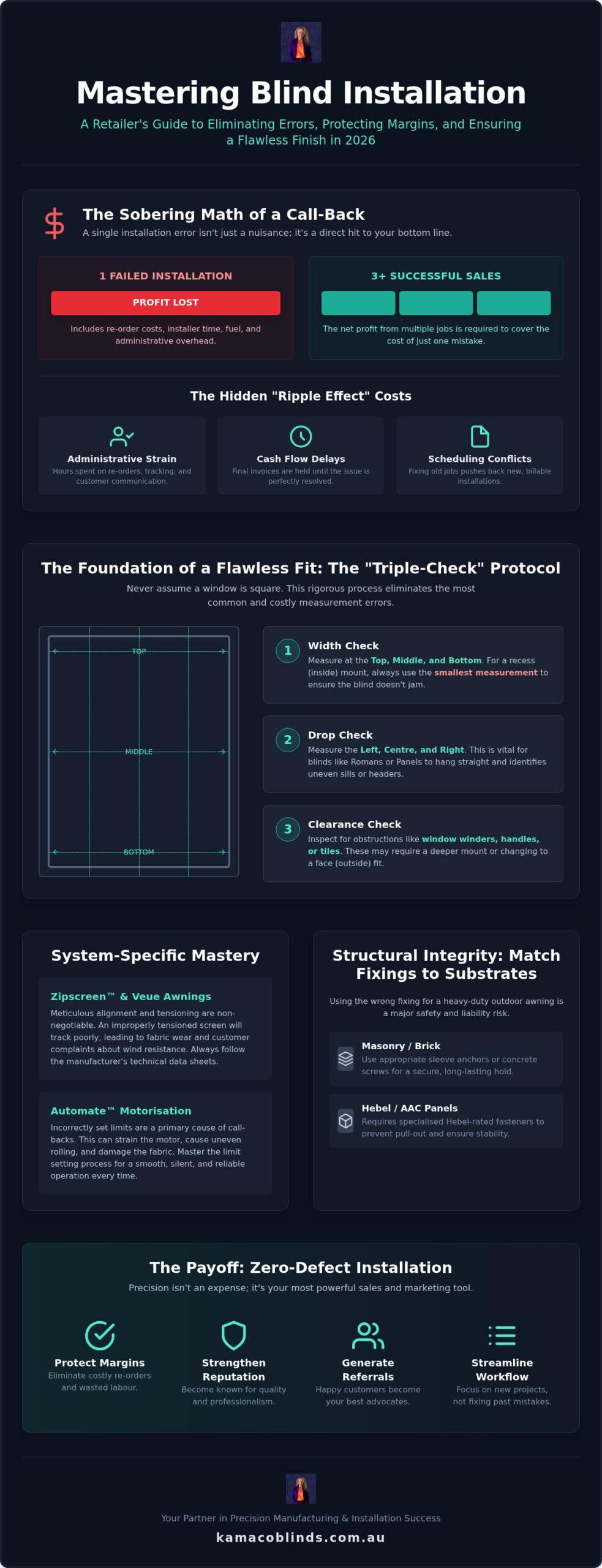
A call-back isn’t just a nuisance. It involves fuel, vehicle wear, and at least two hours of an installer’s time that could’ve been spent on a new, billable project. When you factor in the cost of re-manufacturing a custom skin for a Zipscreen™ or a Veue drop awning, the math becomes sobering. A single measuring error can easily wipe out the net profit of three successful, trouble-free sales. This is why meticulous attention to detail during the initial site visit is your best insurance policy against wasted revenue.
Quantifying the Cost of Call-Backs
To truly understand your profitability, you must look at the “ripple effect” that follows a failed installation. Installation ROI is the ratio of first-time success to total overhead. When this ratio drops, the hidden costs begin to pile up:
- Administrative strain: Your team spends valuable hours re-ordering from the wholesaler and tracking new shipments.
- Cash flow delays: Final invoices remain unpaid until the issue is resolved, tying up capital.
- Scheduling conflicts: Fixing old mistakes pushes back new installations, increasing lead times for your entire customer base.
Protecting Your Retail Reputation in Brisbane
Brisbane is a tight-knit market where word-of-mouth travels fast. A poorly installed blind doesn’t just look slightly off; it signals a lack of care to everyone who visits that home. Professionalism means adhering to the latest window blind safety standards and ensuring every Automate™ motorisation setup is calibrated perfectly for the local climate.
High-quality installation becomes your strongest competitive advantage against low-cost online competitors who offer no local support. By focusing on meticulous execution, you turn every home into a living showroom. This generates long-term referrals and protects your community-rooted identity as a provider of premium, Australian-made solutions. Precision is the silent salesman that keeps your business growing without the need for aggressive marketing hype.
Measuring and Mounting: The Foundations of a Flawless Fit
A perfect installation begins long before your team reaches for a drill. It starts with a steel tape measure and a commitment to meticulous detail. One of the most common blind installation mistakes for retailers to avoid is relying on a single width measurement. Windows, particularly in older Brisbane homes, are rarely perfectly square; a measurement taken only at the top might not account for a taper at the sill or a bow in the middle of the frame.
The Professional Measuring Protocol
Accuracy at the quoting stage ensures a smooth handover weeks later. Your installers should follow a rigorous “Triple-Check” process for every window, regardless of how straight it appears to the naked eye. This level of care reinforces your reputation as a detail-oriented expert who values the customer’s long-term satisfaction.
- Width check: Measure at the top, middle, and bottom. For a recess mount, always use the smallest measurement to ensure the blind doesn’t jam against the frame.
- Drop check: Measure the left, centre, and right. This identifies if the window sill is sagging or if the head is uneven, which is vital for Roman Blinds or Panel Glide Blinds to hang correctly.
- Clearance check: Look for obstructions like window winders, large handles, or decorative tiles. These often require a deeper mounting position or a change from an inside to an outside mount to prevent the fabric from catching.
The distinction between “opening size” and “make size” is where many retail teams stumble. Opening size refers to the actual dimensions of the window cavity, while make size is the finished dimension of the blind including brackets and end caps. If your order form doesn’t clearly state which measurement you’ve provided, you risk receiving a product that is either too wide to fit or too narrow to provide adequate light blockage. Clearly communicating this to your production partner is essential for a zero-defect result.
Navigating Challenging Window Frames
Structural inconsistencies are common, but they shouldn’t compromise the final aesthetic. Using a spirit level is non-negotiable; it identifies “racked” or leaning frames that can cause Roller Blinds to telescope or Zipscreen™ fabric to bunch. A quick “diagonal check”—measuring corner to corner—will confirm if the frame is a true rectangle. If the diagonals differ by more than a few millimetres, you’ll need to adjust the mounting position or use shims to compensate.
By identifying these issues early, you sidestep the common blind installation mistakes for retailers to avoid that lead to unsightly light gaps or fabric fraying. When you partner with a manufacturer that provides comprehensive technical data sheets, you can better predict how these structural quirks will affect the final fit. This proactive approach transforms a potential call-back into a showcase of your technical expertise and commitment to quality.
System-Specific Pitfalls: Zipscreen™ and Motorisation
High-performance systems like the Zipscreen™ require more than just a standard mounting approach. They demand a level of engineering precision that mirrors the quality of the Rollease Acmeda® components themselves. One of the most common blind installation mistakes for retailers to avoid is overlooking the absolute parallelism required for side channels. If these channels are even a few millimetres out of alignment, the fabric will bunch or the zip will jam. This leads to unsightly wear and frustrated customers who expect a seamless outdoor living experience from their investment.
Zipscreen™ Installation and Tensioning
The top box must be perfectly level to ensure an even fabric roll-up across the entire width of the opening. If the headbox is tilted, the material will “telescope” to one side, putting unnecessary strain on both the motor and the zip. This is especially important for wider spans where the weight of the fabric is significant. Calibrating the Ultra-Lock is another critical step for your team to master. This mechanism provides a flat, wind-resistant finish that homeowners love, but it only functions correctly if the tension is balanced. If it’s too loose, the fabric will flutter in the Brisbane breeze; if it’s too tight, the lock won’t engage or disengage effortlessly, making the system feel clunky rather than sophisticated.
Automate™ Motorisation and Limit Calibration
In 2026, smart home integration has become a standard expectation for premium window coverings. Automate™ motorisation offers incredible reliability and quiet operation, but only when the upper and lower limits are commissioned with care. A frequent error is setting the lower limit too low. This causes the motor to continue spinning after the blind has reached its physical destination, creating fabric slack that can lead to the zip jumping out of the track during the next cycle.
- Limit setting: Always test the limits multiple times to ensure the motor stops exactly where the fabric is under ideal tension without overstretching.
- Signal integrity: Troubleshooting signal interference is vital in modern Australian homes. You must ensure that remotes and smart hubs are paired correctly to avoid “drop-outs” within the home’s automation ecosystem.
- Bracket orientation: Rollease Acmeda® hardware is designed for specific travel paths. Mounting a bracket upside down to fit a tight space often results in noisy operation that erodes the premium feel of the product.
By focusing on these technical nuances, you ensure that every installation enhances the beauty of the home while providing the functional utility promised. It’s about moving beyond “good enough” to achieve a zero-defect result that protects your margins and delights your clients. This meticulous approach transforms a standard service into a showcase of craftsmanship that sets your retail business apart from the competition.
Substrate Selection and Structural Integrity
The structural integrity of a window covering depends entirely on the substrate it’s anchored to. A beautiful Zipscreen™ or a heavy-duty Roller Blind is only as reliable as the fixings holding it in place. One of the most common blind installation mistakes for retailers to avoid is treating every wall surface with the same set of standard screws. In Brisbane’s varied architectural landscape, your team will encounter everything from traditional timber and masonry to modern Hebel and thin-gauge steel frames. Each material demands a specific approach to ensure the product remains secure and functional for years to come.
Fixings Guide for Australian Building Materials
Selecting the wrong anchor doesn’t just risk a loose bracket; it can lead to significant property damage if a heavy awning pulls away from the wall. Your installers must be equipped to identify the substrate before they begin drilling. While timber provides a forgiving and solid mount, steel-framed homes require specific gauge screws that won’t strip the thin metal profile. Porous materials like Hebel are increasingly common in new developments and require specialised aerated concrete anchors to prevent the fixing from crumbling the substrate under the weight of the blind.
- Timber: Use high-quality wood screws with sufficient thread depth.
- Steel Frames: Use self-tapping screws designed for the specific thickness of the metal.
- Masonry: Use nylon plugs or expansion bolts for high-density brick and concrete.
- Plasterboard: Avoid using toggle bolts for heavy or motorised blinds; always aim for a direct stud mount to ensure long-term stability.
Wide-span roller blinds are particularly susceptible to “bracket flex.” If the mounting point isn’t perfectly rigid, the brackets can pull inward under the weight of the fabric. This subtle movement causes the tube to bow, leading to the dreaded “smile” effect where the fabric ripples across the centre. Ensuring a rock-solid foundation prevents these aesthetic issues and keeps the operation smooth.
Waterproofing and External Durability
External installations, such as Veue drop awnings in an alfresco area, face the full force of the Australian climate. Every hole drilled into the building envelope is a potential path for moisture. Applying a neutral-cure silicone sealant to mounting holes before inserting screws is a simple but vital step to prevent water ingress. For coastal Brisbane properties, the salt air is relentless. Using stainless steel components and fixings is the only way to prevent rust from seizing the hardware or staining the customer’s patio.
Proper drainage is another often-overlooked detail. Pelmets and cassettes should be checked to ensure they aren’t trapping water against the building. By selecting the right hardware and sealing techniques for the job, you ensure the longevity of the installation and the satisfaction of your client. To ensure your team has the highest quality components for every substrate, partner with Kamaco Blinds for precision-manufactured Australian solutions.
Partnering for Success: How Kamaco Supports Your Retail Team
Successful retail businesses aren’t built on sales alone; they’re sustained by the reliability of the products they install. When you partner with a manufacturer that prioritises precision, you’re not just buying a product; you’re investing in a smoother workflow for your entire team. Kamaco Blinds understands that the common blind installation mistakes for retailers to avoid often stem from a disconnect between the site measure and the factory floor. Our Brisbane-based team bridges this gap by ensuring every Zipscreen™ and Roller Blind is manufactured to your exact specifications, giving your installers the confidence that the product will fit perfectly the first time.
One of the most effective ways to protect your margins is by reducing workshop labour and waste. Our “Cut Skin Service” is designed specifically for retailers who want to focus on the high-value work of installation rather than the tedious task of cutting fabric. By receiving skins that are already precision-cut to size, you eliminate the risk of fabric fraying or uneven edges that often lead to tracking issues later. This service simplifies your internal processes and ensures that the quality of the finish matches the elegance of the homeowner’s vision, all while keeping your overheads predictable.
Technical Resources for Retailer Training
A well-trained team is your best defence against costly errors. We provide comprehensive technical data sheets and installation guides for our entire range, including Automate™ motorisation and Veue drop awnings. Using our detailed order forms ensures that all technical data is captured correctly at the start, preventing the common blind installation mistakes for retailers to avoid that arise from missing deductions or incorrect mounting specs. For a deeper look at how local production supports your business, explore Wholesale Blinds Australia: The Retailer’s Guide to Brisbane Manufacturing or our comprehensive overview of Blinds Manufacturer Australia: The Retailer’s Guide to Quality & Supply in 2026.
Streamlining Your Wholesale Ordering Process
Efficiency in the office leads to excellence in the field. Clear communication during the ordering stage is the most effective way to prevent installation headaches. Our Brisbane-based support team is always available to help you troubleshoot complex projects, whether you’re dealing with unusual structural substrates or intricate motorisation networks. We leverage our deep expertise in Automate™ systems to guide you through the commissioning process, ensuring that your smart home integrations are as quiet and reliable as the customer expects. This commitment to long-term quality and domestic production makes us a full-service partner rather than just a product provider.
Partner with Kamaco Blinds today for premium wholesale support and transform your installation process into a seamless, zero-defect journey that delights your clients and secures your profit margins.
Securing Your Success Through Installation Excellence
Mastering the technical nuances of window covering installation is the most effective way to protect your retail margins and build a lasting reputation in the Brisbane market. By implementing a rigorous “Triple-Check” measuring protocol and ensuring your team understands the specific requirements of various substrates, you eliminate the common blind installation mistakes for retailers to avoid. Precision in the field, paired with high-quality components, transforms a standard service into a showcase of professional craftsmanship that keeps your customers returning.
Choosing a manufacturing partner that shares your commitment to excellence is the final piece of the puzzle. At Kamaco Blinds, we provide Australian-made quality from our Brisbane factory, utilising precision-engineered Rollease Acmeda® components to ensure smooth operation for every project. Our expert technical support for Zipscreen™ and Automate™ systems is always available to help you navigate complex site challenges and streamline your workflow. We’re here to help you turn technical expertise into higher profit margins and zero-defect results.
Join the Kamaco Retailer Network for Premium Wholesale Support and take the next step toward a more efficient, profitable future for your business. We look forward to supporting your journey toward domestic production and long-term quality.
Frequently Asked Questions
What is the most common reason for Zipscreen™ fabric bunching?
The most common cause of Zipscreen™ fabric bunching is the side channels not being perfectly parallel. If the channels taper or flare even by a few millimetres, the zip will drag or the fabric will fold as it descends. Ensuring the headbox is level and using a spirit level on both side tracks is the best way to prevent this tracking issue in Brisbane’s varied architectural styles.
How do I measure for an inside mount if the window frame is out of square?
To measure for an inside mount in an out-of-square frame, you must take three width measurements and use the smallest one. Measuring at the top, middle, and bottom identifies any tapers that could cause the blind to jam. This is one of the common blind installation mistakes for retailers to avoid because relying on a single measurement often results in a product that simply won’t fit into the cavity.
Should I use different fixings for internal roller blinds and external awnings?
Yes, external awnings like the Veue drop awning require vastly different fixings compared to internal roller blinds. External mounts must use stainless steel hardware to resist the salt air in coastal Brisbane and require neutral-cure silicone to seal all mounting holes. Internal blinds focus more on matching the gauge of the screw to the specific substrate, such as timber studs or thin-gauge steel frames.
What are the most frequent errors when setting limits on Automate™ motors?
Setting the lower limit too deep is the most frequent error when commissioning Automate™ motors. If the motor continues to run after the blind reaches its physical limit, the resulting fabric slack can cause the zip to jump out of the side channels. Always test the limits multiple times during the handover to ensure the motor stops precisely where the fabric maintains ideal tension without straining the hardware.
Why is bracket alignment more critical for long-span blinds?
Bracket alignment is critical for long-span blinds because any minor deviation is amplified over a wider distance, leading to “bracket flex.” When brackets aren’t perfectly aligned on a wide Roller Blind, the tube can bow in the centre, creating a “smile” effect in the fabric. This puts uneven pressure on the components and can lead to noisy operation or premature failure of the Rollease Acmeda® internal parts.
How can I prevent light gaps on the sides of inside-mount roller blinds?
Preventing light gaps requires a precise understanding of the difference between “opening size” and “make size.” When you provide an opening size, we apply the necessary deductions for brackets and end caps to ensure a snug fit. If the window is significantly out of square, an outside mount may be a better recommendation to provide full coverage and eliminate the gaps that occur in uneven recesses.
What should I check before installing blinds on a motorised smart home system?
Before installing blinds on a motorised smart home system, you should verify signal integrity and hub compatibility. Ensure the Automate™ pulse hub is positioned to reach all motors without interference from other household electronics. Checking the home’s Wi-Fi stability and ensuring the customer’s smart home ecosystem is ready for pairing will prevent the frustration of “drop-outs” after your installation team has left the site.
Does Kamaco provide technical support for complex retail installations?
Kamaco Blinds provides comprehensive technical support for our retail partners through our Brisbane-based team. We offer detailed technical data sheets, installation guides, and direct troubleshooting for complex projects like large-scale Zipscreen™ installations. This expert guidance is part of our commitment to being a full-service partner, helping you navigate common blind installation mistakes for retailers to avoid while maintaining high profit margins and customer satisfaction.